11 November 2026
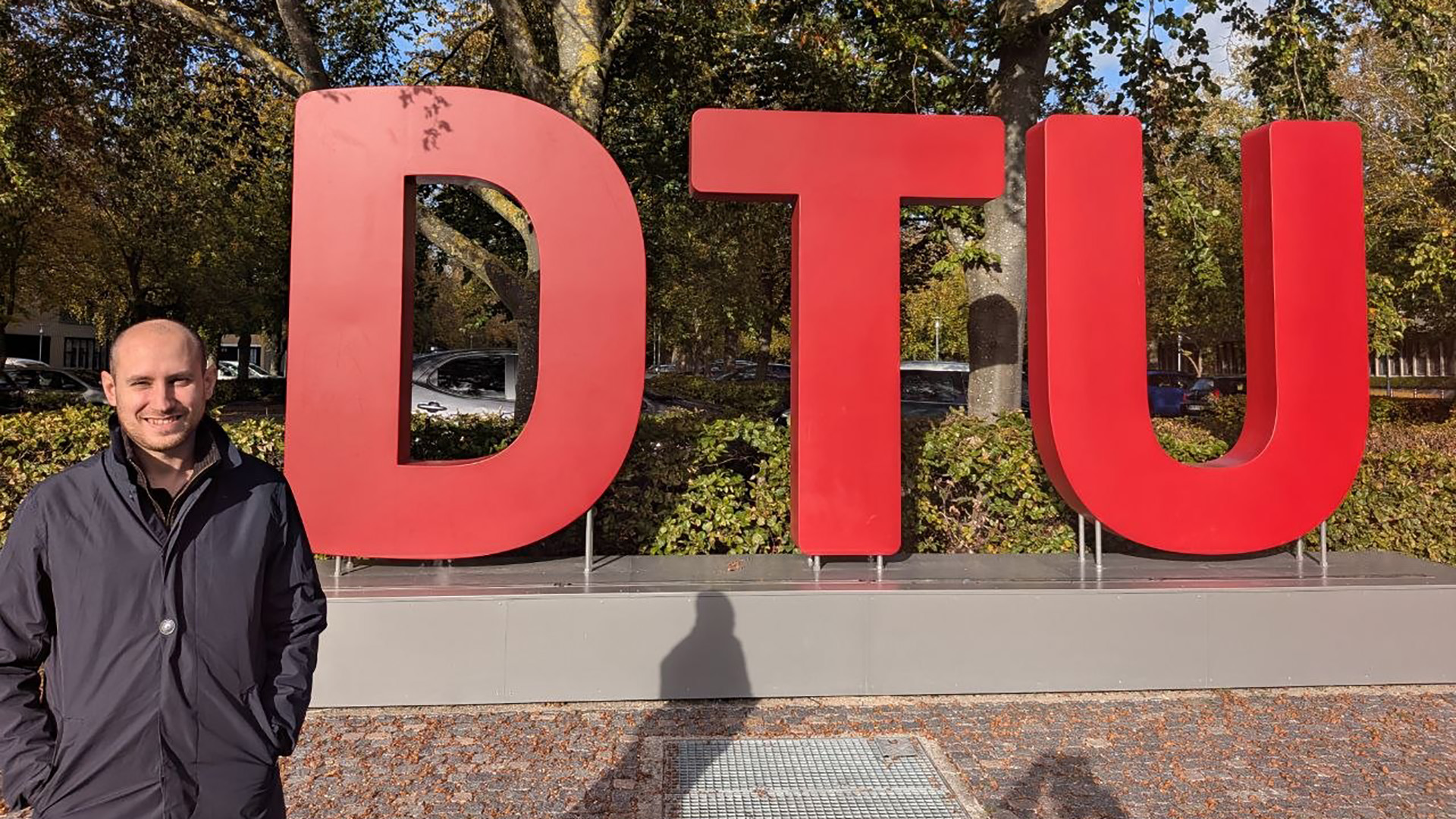
Postdoc Alessandro Cerioli is part of the DIREC project REINS, where he is testing whether headphones do better with a team of small AI specialists than with one big model. Alessandro Cerioli moved to Denmark to study sound. About five years later he is still here, working on a problem for one of the country’s best-known audio brands.
Alessandro trained as a computer engineer at Politecnico di Milano, before coming to Denmark for a master’s in sound and music computing at Aalborg University.
He continued as an embedded developer at the hearing company GN, then took an industrial PhD with Jabra and DTU. Today he is a postdoc at DTU in the DIREC project REINS, working with Bang & Olufsen.
Your headphones are asked to do a lot in a very small space. They have to enhance speech as you move from a quiet office to a busy street, react instantly, and still last through the day on a tiny battery. A big, general AI can handle any situation, but it is too big to fit in an earbud, and too slow if it has to send every sound to a data center and back.
That is the choice Alessandro is working on. Going big means one large AI model that handles every situation. Alessandro calls it the global solution, one that is “less expert” but covers everything. Going small means several compact models, tinyML (Tiny Machine Learning), each trained as an expert for one specific context.
“The more you improve the quality, usually the more resources you need on the hardware. So it’s about finding the optimal trade-off.”
The compromise Alessandro is working on is not only about headphones. Most of today’s AI is built big, and it takes a great deal of energy. Alessandro thinks that the way we use AI needs to be calibrated, because it is not really sustainable at the moment, neither financially nor in terms of energy and water.
AI could be used in many more places, closer to where things happen, and with a lot less energy. Finding out where going big pays off, and where going small is enough, is the first step.
Most of today’s AI runs in large data centers. Your device sends data over the internet, a powerful computer does the work, and the answer comes back. Edge AI runs directly on the device itself, such as a pair of headphones or a sensor, which has only a little computing power and battery. That saves energy, removes the delay of sending data back and forth, and keeps working without an internet connection.
TinyML means AI on very small, low-power chips (microcontrollers), often with only kilobytes of memory and a tiny battery. A pair of earbuds is a typical example.
Adaptive AI is about, yes, adapting: instead of doing the same thing all the time, it changes how it works as conditions change, for example by switching to a different specialised model when the language, the noise or the task changes.
Alessandro’s work is one part of REINS, a DIREC project that runs from 2025 to 2027. Its aim is AI that runs efficiently on small devices with very little computing power. The project brings together DTU, the University of Southern Denmark, the Alexandra Institute, Bang & Olufsen and Leica Geosystems.