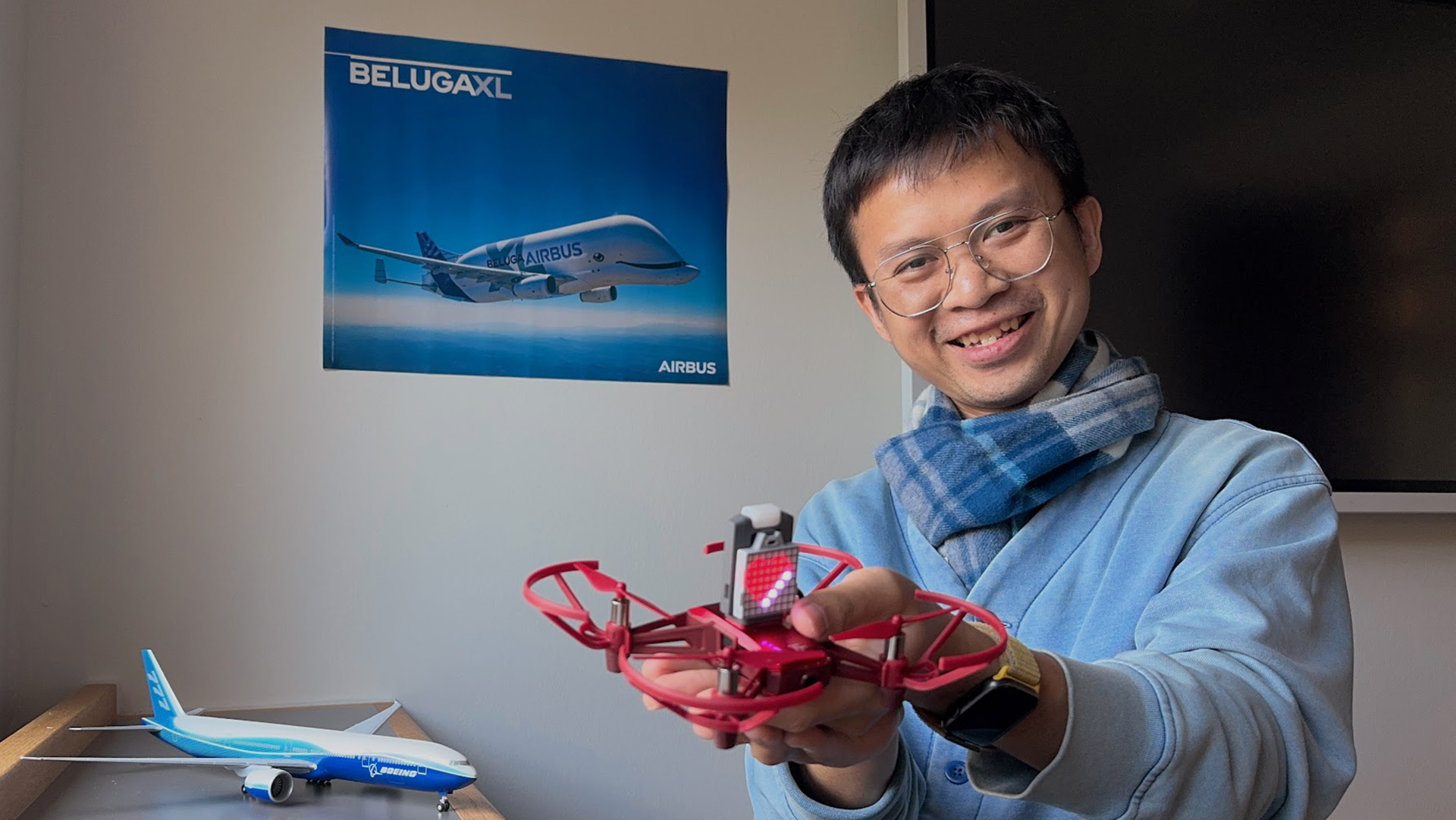
From firefighting in Thailand to critical infrastructure in Denmark
Meet DIREC researcher, Chandhawat Boonyard
Chandhawat Boonyard has spent most of his career working out how drones can be useful to people who are busy doing something difficult. He started in aerospace engineering, worked as a drone researcher at his university in Thailand and spent a year as an aircraft engineer before returning to academia.
He took a master’s degree in systems engineering at ENAC, the French civil aviation school, and went on to doctoral work in human-computer interaction, specializing in human-drone interaction. His thesis looked at how a drone could assist firefighters in Thailand, where budgets are tight and conditions are rarely ideal. Today, he brings that expertise into PERSIST, where researchers and industry partners are exploring how drones can become collaborative teammates in critical infrastructure
For Chandhawat, however, the technology is only part of the challenge: “I want the drone to adapt to human behaviour. I don’t want drones to be something that frightens people.”
You are getting a little too close
Most people are comfortable with a drone surveying from high up – it is when it comes closer that it can be perceived as too aggressive. Chandhawats research focuses on this. A drone might notice that someone has walked onto the site without a safety vest or a helmet, and say so before anything goes wrong. It might spot a fault in a machine, report it, guide the technician to the exact spot, and then use its thermal camera to confirm that the repair has worked.
Chandhawat calls this part of his work “hear to help”, which is a small joke as well as a description. “‘Hear” also means hearing, because the drone can communicate with you.” The communication runs both ways. A technician can talk to the drone over the radio, or answer it with a thumbs up or a thumbs down.
Chandhawat has now moved to Aalborg for two years as part of PERSIST, where he joins Tim Merritt and the rest of the team.
We are delighted to welcome Chandhawat to Denmark and to the PERSIST project.
PERSIST - Persistent Drone Operations at Critical Infrastructure
Project period: 2025 – 2027
Partners: DIREC, Aalborg University, University of Southern Denmark, HOFOR, Ørsted and Robotto.ai