A case for more sustainability – and independence
We throw away more electronics every year, and most of the valuable metals and components inside are never recovered. At the same time, Europe wants to depend less on imported raw materials and has set goals for recycling far more of the materials it already has. New EU ecodesign rules will also increasingly expect products to be repairable and easy to take apart.
All of this points the same way: more products will come back, and more of them will have to be taken apart carefully rather than shredded. If people have to do that work by hand, it won’t scale.
From 100 demonstrations to 1
A robot seems like the obvious answer. But disassembly is many small, different tasks, and robots have been expensive to teach. The AI models behind modern robots, so-called end-to-end models, translate a camera image directly into movement. They usually need 30 to 100 demonstrations for every single task.
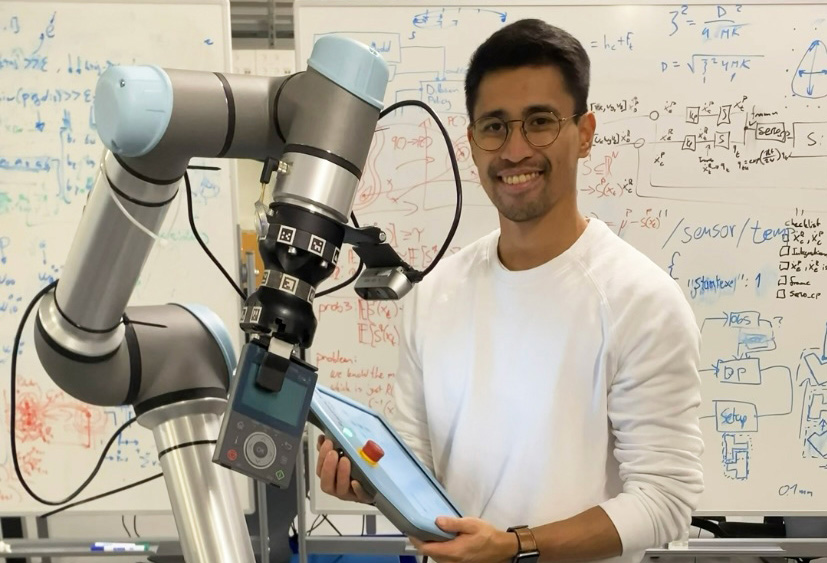
“It’s super labour-intensive,” says Wilbert. “I got kind of fed up with that.”
So he found a method where one demonstration is enough. The robot watches the task once and can repeat it, even when the part is moved or turned.
He showed it live at Danfoss. The company’s own staff guided the robot with a 3D mouse while they took the product apart, and the robot learned from them. “They could see that you can actually train it yourself,” he says.
That changes the cost of automating disassembly. If you only need to show each step once, many more products become worth taking apart.
Research shaped by a real problem
The DIREC project MOTUS brings together the University of Southern Denmark, IT University of Copenhagen, Danfoss and Universal Robots. Wilbert says the industry case has improved the research.
“Working with the partners has changed the direction of my PhD for the better. The research is more rigorous than it would have been if I had worked on my own, and it is aimed at a problem that really matters.”
The materials are already there. A robot that learns from one demonstration could make it worth getting them out of many more products.