
19 February 2025
Researcher Relay #2
Numerous projects are currently working to enhance the healthcare sector with advanced artificial intelligence. However, according to Naja Holten Møller, Associate Professor at the Department of Computer Science at the University of Copenhagen, one essential factor is often overlooked: the people who are directly impacted by the technology. This is the second part of our Researcher Relay series.

The construction of the new hospitals presents a unique opportunity to optimize the sector. New AI tools are ready to be implemented, but the question remains: which technologies truly make sense for integration into Danish hospitals?
The question was posed by Thomas Hildebrandt to Naja Holten Møller in the first part of DIREC’s Researcher Relay. You can read the article here.
In this article, Naja Holten Møller provides her insights and passes the baton forward.
Since 2015, Naja Holten Møller has worked with companies such as Systematic, PowerNet, SaniNudge Bispebjerg Hospital, and the Danish Society for Patient Safety to create a human-centered approach to the future healthcare system. The project is called iAware.
“Currently, we see an immense interest in saving costs within hospitals through complex AI models. But it is crucial that we involve staff, families, and patients in the discussion and approach the solutions more pragmatically,” says Naja Holten Møller.
She emphasizes that history has demonstrated how even minor changes to hospital workflows can lead to significant problems.
“We often assume that we can easily automate everything, from waste management to resource planning. But hospitals are highly complex systems. You must understand all the interdependencies before making any changes,” she adds.
In pursuit of understanding, Naja Holten Møller and her research team (Postdoc Trine Rask Nielsen, Postdoc Christoffer Olling Back, and Professor Jakob Grue Simonsen) employ participatory design methods to ensure that solutions are developed in close collaboration with those who will use them daily.
Using a prioritization matrix, healthcare staff have ranked how they would like to be treated at the hospital. Additionally, through online focus groups, the researchers aim to equalize power dynamics, giving all patients an opportunity to be heard.
Through these methods, Naja Holten Møller has found that many solutions don’t require large data centres or super-fast chips.
“We often forget that there are many ways to use algorithms and data, and that they can be gathered very simply using the existing devices of the care staff, without creating additional documentation burdens,” she says, adding:
“If we are to fully leverage AI’s potential in healthcare, we need to look beyond just cost savings and efficiency. We must create calm, well-being, and security for staff, patients, and families. We need to break down the walls between the patient’s room and the ward.”
In the iAware project, the research team have set goals aimed at increasing calm for patients, relatives, and staff. In the course of their work, they concluded that providing information to patients and relatives is crucial.
Currently, patients often struggle to get simple answers to basic questions, such as when their scan is scheduled, whether they can receive pain relief, or when a nurse last visited. This can lead to falls if patients need to leave their room to ask the staff.
“It may sound surprising, but in Denmark, we have simply overlooked the importance of easily accessible information in patient rooms. We can solve this very simply by connecting staff phones via Bluetooth to a screen in the room, so it automatically records when the patient last had a nurse visit,” Naja Holten Møller says.
This straightforward form of digital support ensures that communication remains with the patient, rather than disappearing out the door with the staff. Looking ahead, Naja Holten Møller hopes more projects will emerge based on simple digital solutions.
“Rather than solely focusing on cost savings in terms of man-hours, politicians and decision-makers now have a golden opportunity to create calm, well-being, and security for patients, families, and staff,” she concludes.
Naja Holten Møller passes the baton to Stig Strandbæk Nyman, Postdoc, from Copenhagen Business School with the question: “How can we support workplaces in ensuring that employees are adequately prepared for the new challenges posed by digitalization and AI?”
Interested in AI in the public sector?
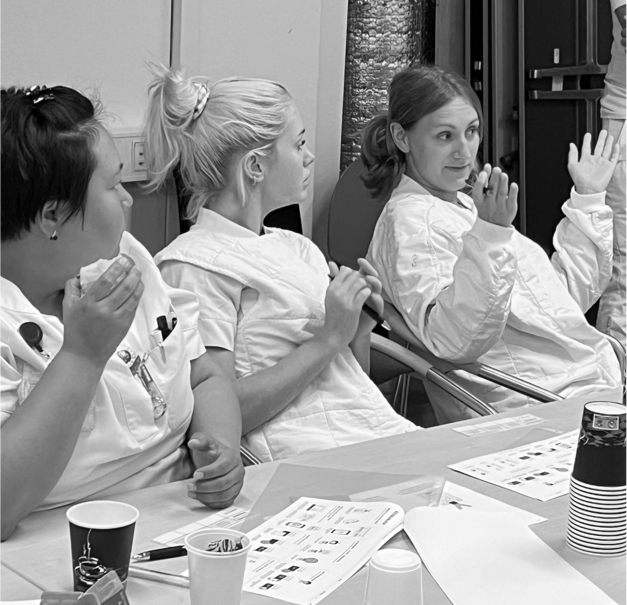
Naja Holten Møller and her research team have designed their research to engage both care staff, patients, and relatives through focus groups and workshops.