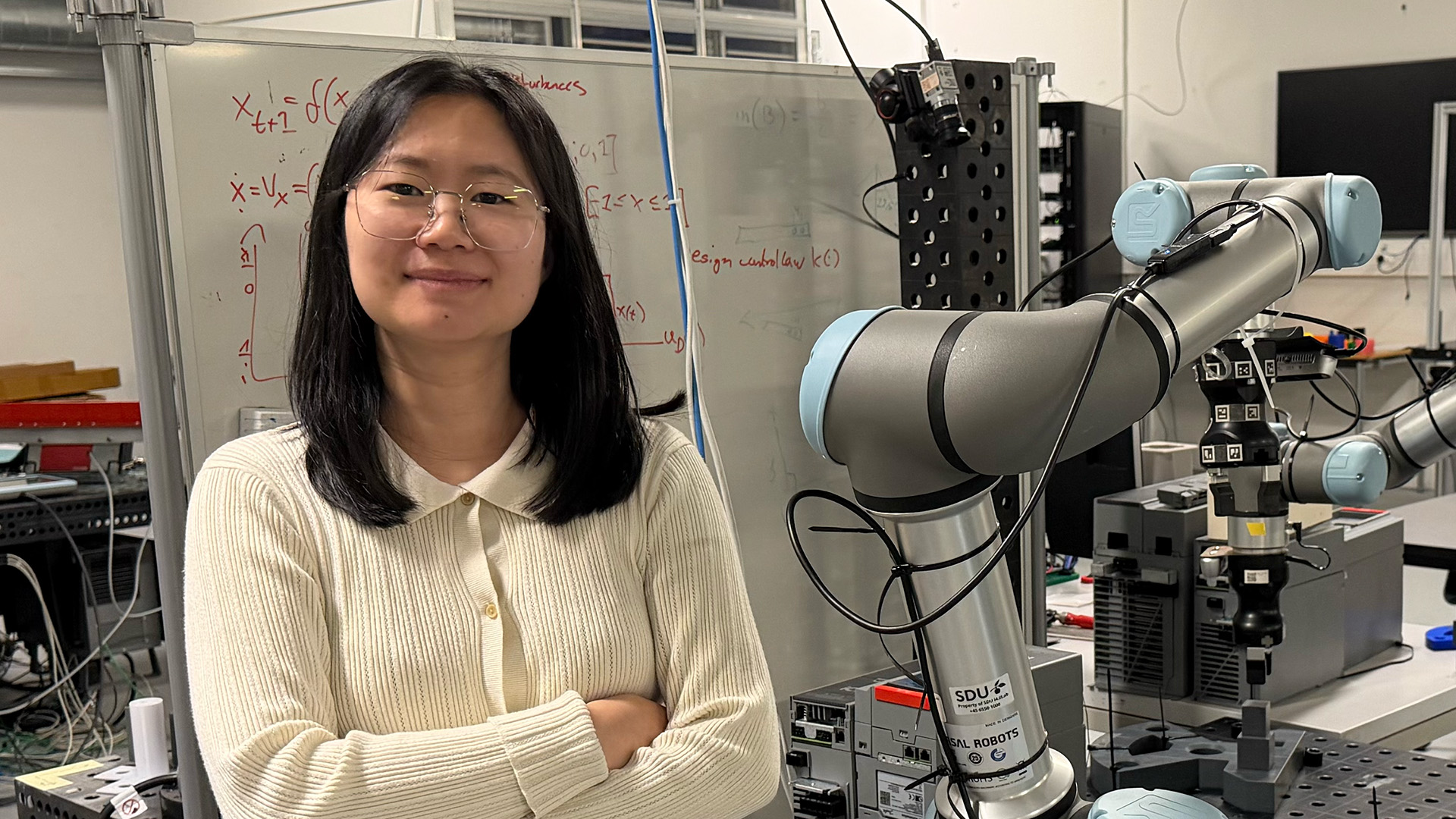
It’s not easy to face our own shortcomings. Chengyandan Shen has taken on the job of teaching robots to recognize their mistakes. Most of us have seen AI get something wrong in an answer on a screen. When a robot gets something wrong, it happens in the “real” world: on a production line, with expensive machinery, or potentially in a hospital.
“We help the robot realise when it is uncertain, so we can correct that behaviour and make it perform more reliably and efficiently,” Chengyandan explains.
Teaching robots to know when they’re wrong
Seven years ago, Chengyandan moved from China to Denmark to study robotics at DTU. She had a bachelor’s in mechanical engineering and a strong interest in how machines move. In Denmark she discovered reinforcement learning, a branch of AI where systems learn by trying, failing and adjusting.
That interest led her to an industrial PhD. Along the way she realised what she enjoyed more in researching the open questions in robotics and the testing of ideas that might or might not work. Today she is a postdoc at SDU Robotics and part of the DIREC project MOTUS.
Chengyandan particularly enjoys the collaboration with Danfoss, where the team automates a real setup and shows that uncertainty-aware methods can improve an actual industrial problem.
“When an idea I created works, that is a really good moment. And seeing the real robot move the way you want is very satisfying.”
Trustworthy AI as a competitive edge
There is a nice symmetry in Cheng’s work: She teaches robots to admit when they are unsure, and what she values most about Danish research is that researchers are allowed to be unsure too.
“You can take your time, and you can fail. We are genuinely curious about whether and why something works or not, and I think that is real research. This is where innovation comes from.”
The global AI race is often about size and speed, but perhaps the race should also be for something else: technology you can rely on. A robot that knows when it’s wrong is a robot you can start to trust in a factory or a hospital.